In commercial art procurement, conversations usually revolve around design approval, pricing, lead time, and installation schedules. Drying time rarely receives the same attention.
Yet in large oil painting production, drying time is often one of the clearest indicators of final quality.
A painting may appear complete when the surface feels dry. In reality, oil paint behaves differently from most industrial coatings. What looks finished can still be undergoing internal chemical change.
For hotels, offices, hospitality projects, and large-scale wall art programs, understanding drying time helps buyers avoid hidden defects that only appear after installation.
One of the most common misconceptions in commercial artwork sourcing is assuming oil paint dries through evaporation.
It does not.
Oil paint cures primarily through oxidation — a slow reaction between oil binders and oxygen in the air.
This means two timelines exist simultaneously:
The outer layer becomes touch-safe.
The deeper paint structure continues stabilizing.
Large oil paintings complicate this process because thickness, layering, and environmental conditions become harder to control consistently.
A painting can look finished long before it becomes structurally stable.
Small artworks and oversized commercial paintings do not scale equally.
As artwork dimensions increase:
Production teams managing large orders must account for these variables from the beginning.
What works in a studio sample does not always translate to a 2-meter-wide installation.
One of the most common production failures occurs when the outer paint film hardens before lower layers stabilize.
This imbalance creates pressure beneath the surface.
Over time it may lead to:
Interestingly, these issues often appear months after delivery rather than immediately after production.
That delay makes root-cause analysis difficult.
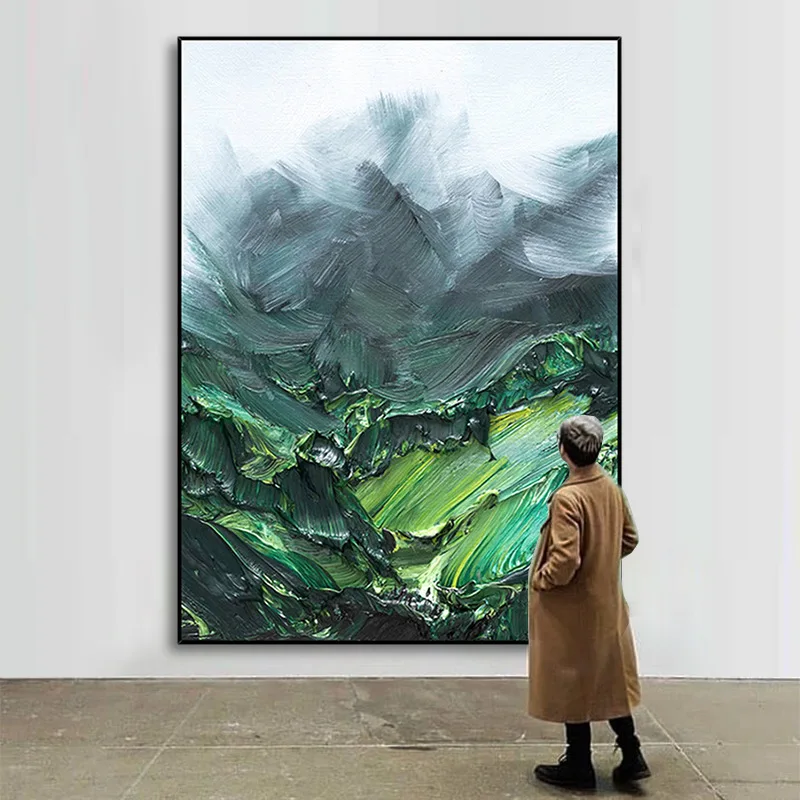
Large commercial oil paintings often rely on texture to create visual impact.
However, thicker paint means slower oxygen penetration.
Heavy applications may require dramatically longer curing periods than visually smooth surfaces.
Factors that influence drying include:
More material means slower curing.
Some pigments naturally dry faster than others.
Drying oils and additives alter curing behavior.
Humidity, airflow, and temperature directly affect oxidation.
Professional production schedules account for all four.
Commercial projects usually operate under deadline pressure.
Openings move forward. Installation windows shrink. Procurement timelines compress.
Artwork production often absorbs that pressure.
When drying stages are shortened, suppliers may encounter:
Temporary visual perfection masking internal instability.
Semi-cured paint transferring texture into protective materials.
Soft paint becoming sensitive to vibration.
Sections curing differently after installation.
Ironically, speeding production often increases total project cost through replacements and corrections.
Drying is not only structural.
It also influences visual performance.
During curing:
Paintings evaluated too early sometimes appear richer than their final state.
Professional suppliers understand this and allow visual stabilization before approval.
This becomes especially important for hospitality projects requiring batch consistency.
Drying time is not simply waiting.
It is controlled waiting.
Professional production environments manage:
Large paintings benefit from gradual environmental transitions rather than aggressive drying conditions.
Faster is rarely better.
Predictable is better.
Drying processes are rarely visible during supplier evaluation.
Useful questions include:
These questions often reveal more about production maturity than price discussions.
Across large hospitality installations, one pattern appears repeatedly.
Projects with stable visual quality years later were not necessarily the most expensive.
They were usually the projects where production teams respected material timing.
Drying time does not create visible luxury.
It creates invisible reliability.
Guests never notice proper curing.
They only notice when something goes wrong.
Large oil painting production is not simply painting at scale. It is managing chemistry, structure, and time.
Drying time influences durability, appearance, transport performance, and long-term consistency.
For commercial buyers, asking “How long does production take?” is useful.
Asking “How long do paintings cure before shipment?” is often the more important question.
 Hot News
2025-10-20
2025-09-08
2025-09-01
2025-02-01

Discover Free Cloud Arts, where art is more than just visuals—it's an emotional journey. Our innovative designs and unique concepts bring something different to the world of art. Explore our collections of 100% handmade paintings, canvas prints, and layered mat glass art.
No. 2980, Zhufeng Road South, Doumen District, Zhuhai, Guangdong, China, 519170
Copyright © 2026 China Zhuhai Free Cloud Arts Co., Ltd. All rights reserved. Privacy Policy;
 EN
EN