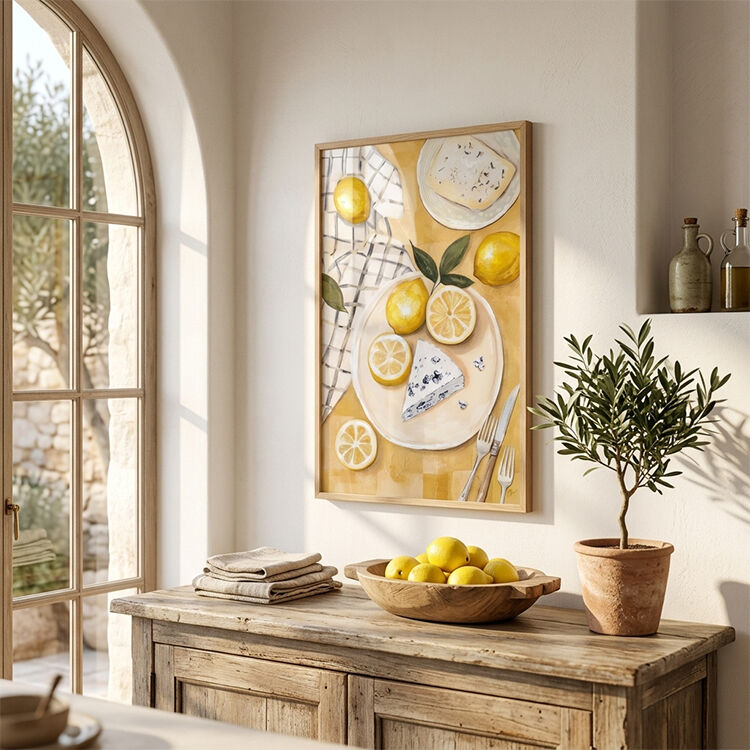
Selecting oil paintings for a commercial project is very different from choosing art for a private home. In business environments—hotels, offices, retail spaces, or mixed-use developments—art must perform on several levels at once. It has to look good, of course. But it also needs to support brand positioning, withstand daily use, and scale consistently across multiple spaces.
Many procurement teams underestimate how strategic this decision actually is. From my experience observing large commercial art projects, most issues don’t arise from taste, but from misalignment between artwork, space, and long-term use.
This guide breaks down how professionals approach oil paintings for commercial projects, step by step.
A common mistake is selecting paintings first and figuring out placement later. In commercial interiors, the logic should be reversed.
Ask practical questions before looking at styles:
Is the space client-facing or staff-only?
How long do people stay in this area?
Is the atmosphere meant to calm, energize, or impress?
What lighting conditions dominate the space?
For example, hotel guest rooms benefit from softer, emotionally neutral oil paintings. Lobbies and reception areas, on the other hand, often require larger, more assertive pieces that establish identity within seconds.
Art that ignores function may still look attractive—but it rarely works.
Oil paintings continue to hold a unique position in commercial wall art because of their physical depth. Unlike prints, oil paintings interact with light. Brushstrokes create subtle shadows. Color layers shift slightly throughout the day.
In premium offices and hospitality environments, this tactile quality communicates value and permanence—qualities many brands want to project without stating them explicitly.
That said, not every project requires fully hand-painted work. Procurement teams should understand the spectrum:
Fully hand-painted oil paintings for flagship areas
Semi-hand-painted or studio-produced works for large-scale consistency
Avoiding purely printed canvases when authenticity is part of the brand story
Choosing the right level is a strategic decision, not just a budget one.
Commercial art should never compete with branding—it should quietly reinforce it.
Minimalist brands often benefit from restrained abstract oil paintings with controlled palettes. Hospitality brands may lean toward narrative or organic compositions. Corporate environments frequently prefer structured forms that suggest clarity and order.
What matters is not trend-following, but coherence. When art style contradicts brand tone, the space feels confused, even if individual pieces are well made.
One useful exercise is to describe your brand using three adjectives, then eliminate any artwork that doesn’t visually support at least two of them.
In commercial projects, size mistakes are far more damaging than stylistic ones.
Oversized oil paintings can anchor a lobby beautifully—or overwhelm it. Undersized pieces often disappear entirely, especially in large offices or hotel corridors.
Professionals typically consider:
Wall width and ceiling height
Viewing distance
Furniture scale
Sightlines from entrances
A medium-quality painting at the right scale often outperforms a premium piece that’s poorly sized.
Commercial environments are unforgiving. Cleaning routines, air conditioning, sunlight, and humidity all affect artwork longevity.
When selecting commercial oil paintings, procurement teams should examine:
Canvas thickness and tension
Wood frame dryness and stability
Varnish type and protective coating
Edge finishing for gallery wraps
Paintings that look fine on day one but degrade within a year undermine the investment—and the brand.
This decision shapes the entire procurement workflow.
Custom oil paintings work best when:
Brand colors must be precisely matched
A visual narrative spans multiple spaces
Large quantities need visual consistency
Ready-made works may suit:
Short-term projects
Budget-sensitive installations
Secondary spaces
The mistake is deciding too late. Switching from ready-made to custom mid-project often causes delays and budget overruns.
In commercial projects, a good painting from an unreliable supplier is still a bad decision.
A professional oil painting supplier should demonstrate:
Capacity for bulk or phased orders
Clear quality control procedures
Stable artist teams, not ad-hoc labor
Realistic lead times
Secure international packaging
From a procurement perspective, consistency across 100 pieces matters more than brilliance in one sample.
Commercial spaces rarely rely on a single artwork. Even when paintings differ, they should feel related.
This can be achieved through:
Shared color logic
Repeated compositional elements
Consistent framing or edge style
Controlled variation in size
A coherent collection creates visual rhythm across a space, which guests and employees perceive subconsciously.
Oil paintings are physical objects. Their weight, hanging systems, and access for maintenance matter.
Before finalizing selection, confirm:
Wall load capacity
Mounting hardware standards
Access for future cleaning or replacement
Fire and safety regulations (especially in hospitality)
Artwork that is difficult to install or maintain quickly becomes a liability.
After reviewing many commercial art projects over the years, one insight stands out: the most successful installations feel effortless. That ease is the result of careful planning, not luck.
Choosing the right oil paintings for commercial projects means balancing aesthetics with engineering, brand language with human experience, and creativity with operational reality. When these elements align, the artwork doesn’t just decorate the space—it supports it, quietly and consistently.
 Hot News
2025-10-20
2025-09-08
2025-09-01
2025-02-01

Discover Free Cloud Arts, where art is more than just visuals—it's an emotional journey. Our innovative designs and unique concepts bring something different to the world of art. Explore our collections of 100% handmade paintings, canvas prints, and layered mat glass art.
No. 2980, Zhufeng Road South, Doumen District, Zhuhai, Guangdong, China, 519170
Copyright © 2026 China Zhuhai Free Cloud Arts Co., Ltd. All rights reserved. Privacy Policy;
 EN
EN